Before we start, I want to say I am politically agnostic. This is neither an anti-Labour piece, nor a defence of their predecessors; even if I were a good enough writer to create one!
Also, this article was prompted by the work that Ruxandra Radulescu is undertaking by combining neuroscience, advisory and creativity with business leaders – I cannot claim the credit.
In my humble opinion, UK Plc has been let down by successive governments of all hues. But why?
As much as politicians can attract our ire, it is a safe assumption that the vast majority of career politicians went into politics to make our world a better place. Although they do not always come with the requisite skill set, as I discussed in a previous article. But this doesn’t begin to explain the why.
Similar democracies to ours seem to get it right with broadly the same conditions.
Our friends in Japan plan decades ahead of need, building industrial strategy, sovereign technology and talent pipelines – often preparing for demographic and technological shifts long before they hit. Singapore treats adaptability as a vital piece of national infrastructure and designs its future before it arrives. Denmark rewires energy, education and economic systems with the assumption that disruption is permanent.
Now, I appreciate we have ‘borrowed’ some policy from Denmark of late, but sadly, the wrong one in my view.
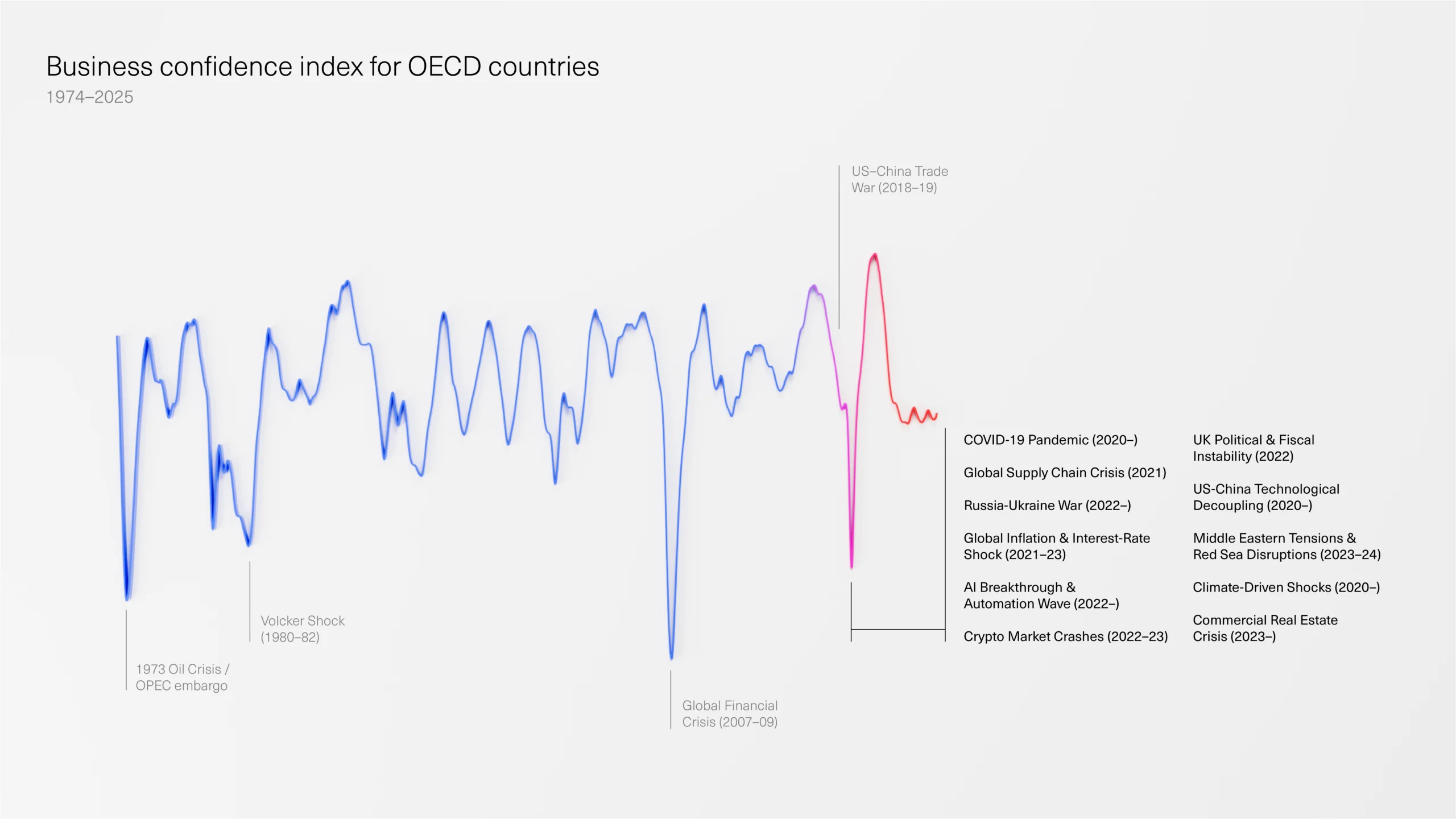
I have concluded that the UK Government is playing a 1997 game in 2025. This was a weak but relatively stable approach for much of the post war era, because things changed. Just not that much and not that often. This is no longer our collective reality.
We are now in an era of ‘discontinuous change’. This is when the world stops behaving like the one you were trained to navigate did. Patterns do not just bend anymore, they break. The assumptions that were predictable for decades stop working. The indicators you relied on lose worth. It is not evolution; it is rupture.

Trying to govern a country or run a business through discontinuous change using historical templates is like playing a 1997 game in 2025. The rules have changed. There is no cheap capital, investment has been attracted elsewhere, technology is advancing at a rate we could never have predicted, supply chains are impacted, the labour force is on the move, geopolitical instability is on the rise… I could go on, but I am still only one coffee into my morning.
This is precisely where the UK government now sits. Governing a transformed world with thinking recycled from the last one. It is not just a governmental malaise; it impacts business just as acutely.
Instead of recognising that global conditions have fundamentally shifted: AI acceleration, climate-driven economics, demographic inversion (apologies, I had a second coffee), decisions are still framed around what happened yesterday. Strategy has been replaced by justification. Vision by narrative management. It is policymaking for a world that no longer exists.
Meanwhile, the countries that understand discontinuous change behave very differently. They prepare for change rather than react to it. They anticipate that conditions they could not plan for will arise and make decisions accordingly when they do.
The UK, in turn, acts like a perpetually surprised middle manager.

Brexit, shocker, was being discussed when I was four. Covid, what, did nobody watch Outbreak (Dustin Hoffman was brilliant)? AI, where did that come from? A formal scientific discipline founded in 1956 to be precise. But the interest rate fluctuations… remember Black Wednesday? That was 1992.
While we have been perfecting the art of political surprise, others have been perfecting their response to uncertainty. That posturing might have worked in a linear world. It is fatal in a discontinuous one. Discontinuous change punishes backward-looking leadership.
It rewards those who can act without the safety of precedent. Leaders willing to design in ambiguity invest ahead of need and accept that historical comparisons are more misleading than helpful.
The UK has all the ingredients: a world-class research base, a creative and scientific ecosystem, entrepreneurial energy and deep human capital. What it lacks, and arguably has for many decades, is a government willing to stop playing a 1997 game in 2025.
If we continue to search backwards for explanations, we will miss every forward opportunity.
In a world dominated by discontinuous change, once you fall behind, you do not catch up, because the rest of the world has already moved to a new game entirely.

In this world, the advantage no longer belongs to those who predict perfectly, but to those who can think differently. That is exactly why we built Compartir at the intersection of neuroscience, advisory and creativity.
We help leaders understand how their brains respond to ambiguity, how their organisations behave under pressure, and how to design the future rather than inherit it.
Speak to Ruxandra Radulescu. Her work sits at the frontier of human decision-making. Not just explaining how leaders adapt, but helping them build the capacity to advance when the old rules no longer apply.
Explore our articles

Aligning brand, purpose and strategy – A conversation with Eve Vlemincx | Part 2

Aligning brand, purpose and strategy – A conversation with Eve Vlemincx | Part 1

“Work the heck?”: highlighting the dangers of the UK’s new policies to businesses, international talent and young people.
“Work the heck is going on?” A question everyone in the current job market has asked themselves at one point (and yes, pun intended).
Should digital transformation be applied to enhance tech efficiency in the shipping sector? AI, IoT, digital twins and more.

The science of building brands for the intangible
For years, Within International has specialised in building brands for the hardest thing to define: the intangible.
The case for neuroscience in business

Outside looking in: a call for change in shipping

The city that never sleeps
We usually work in words – but this time, the pictures said it better. A visual story from our recent New York adventure.