


AI knows an extraordinary amount about us. It knows what we search for. What we read. What we buy. What we post. It can process almost everything humanity has written, published and recorded. But most of that is evidence we have left behind. It is not the same as asking us.
AI has learned the internet. It has not learned humanity.
Sentiment AI is built around a different idea. What if AI could have an ongoing relationship with real people? Not scrape them. Not profile them from their behaviour. Actually, talk to them, privately, super securely and with permission, then remember enough context for the next conversation to mean more than the last. All anonymously. That is what we are building.
People talk to Sentiment AI about what they think, what matters to them and the experiences behind their perspective. Then they come back. And when they do, the conversation continues. The system begins to understand not simply what somebody thinks today, but how their perspective has developed over time. That changes what becomes possible.
Perspective becomes something AI can learn from directly.
Not another dataset built from the traces people leave online. Something that does not exist until you ask.

The objective is time
One conversation can tell you something interesting. A history of conversations can tell you something very different. Someone’s view today becomes more valuable when you understand what they thought a year ago. You can see what changed. You can understand the context around that change. Do that across enough people, for long enough, and you begin to create something that is extremely difficult to replicate.
We call it the perspective graph.
It is a growing map of human perspective built from private, permissioned conversations over time. Not a database of quotations. Not a collection of individual opinions for organisations to inspect. The value is in the intelligence that emerges across them. How perspectives relate. Where they diverge. What appears to be changing. Which experiences seem to matter.
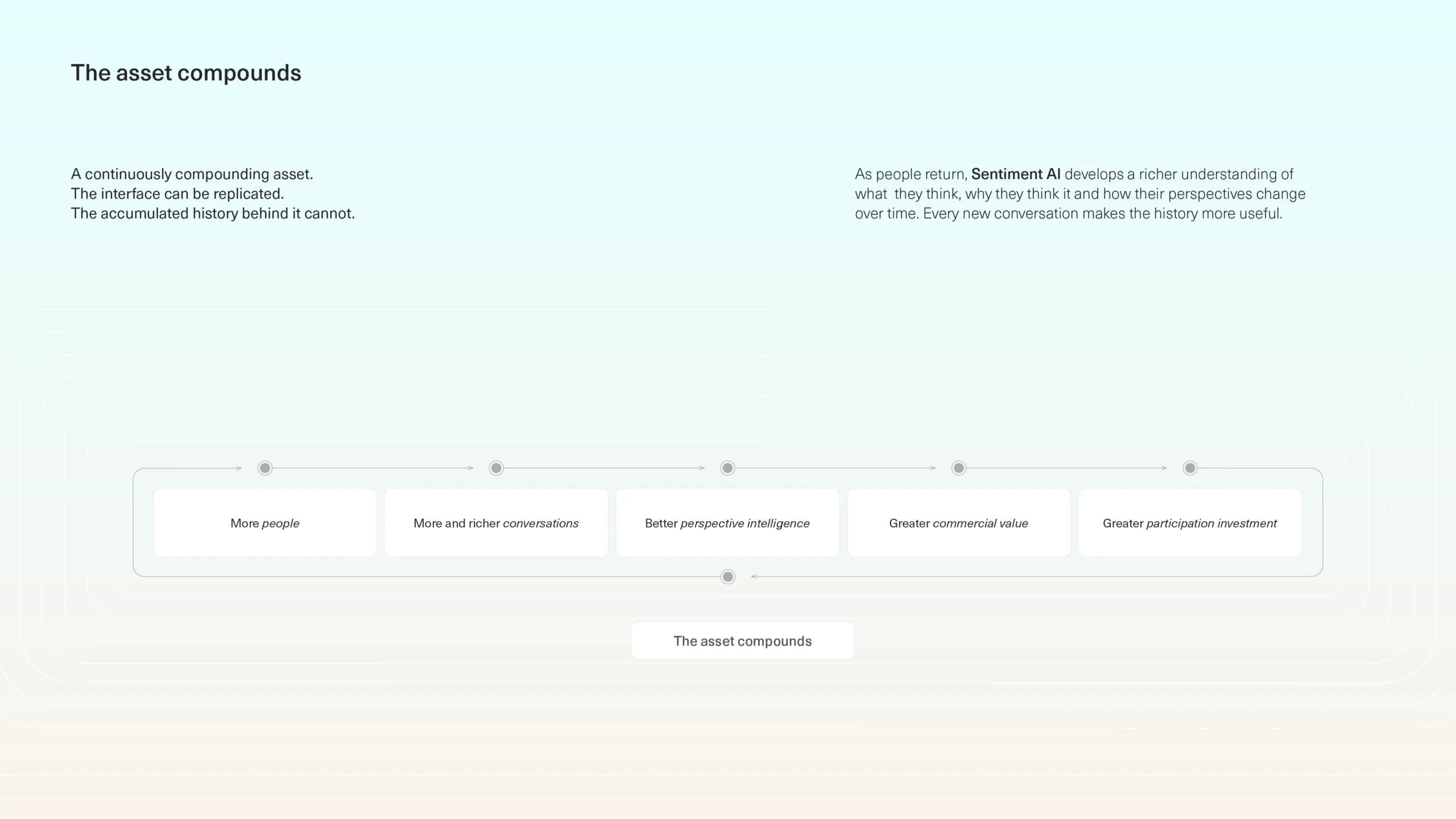
Participants keep their privacy. Sentiment AI keeps the continuity. And continuity is where the asset begins to compound. Every returning participant makes their own history richer. Every new participant adds another perspective. Every year makes the accumulated intelligence harder to reproduce.
You can copy an interface. You cannot copy time.
We are not starting from zero
The experience layer already exists. Enter Agora has given us the foundation for large-scale digital participation and conversation. Sentiment AI takes that foundation somewhere new. The next step is not simply to build a better research product. It is to find out whether continuously accumulated human perspective can become an intelligence layer in its own right. We believe it can.
Importantly, we do not need to wait for the entire vision to exist before the business works. We start with questions organisations already need answered. Companies already spend enormous amounts trying to understand people. They commission research. They run communities. They buy datasets. They interview customers, employees, patients and experts. Sentiment AI gives them a new way to do that.
Organisations commission intelligence from the network. Those programmes generate revenue, but they do something else as well. With permission, they help grow the underlying perspective intelligence. So, the commercial activity does not sit separately from the asset. It helps create it.
Over time, the opportunity moves beyond individual programmes. Organisations can maintain an ongoing relationship with perspective intelligence relevant to them. Eventually, other AI systems can access parts of that intelligence as infrastructure.
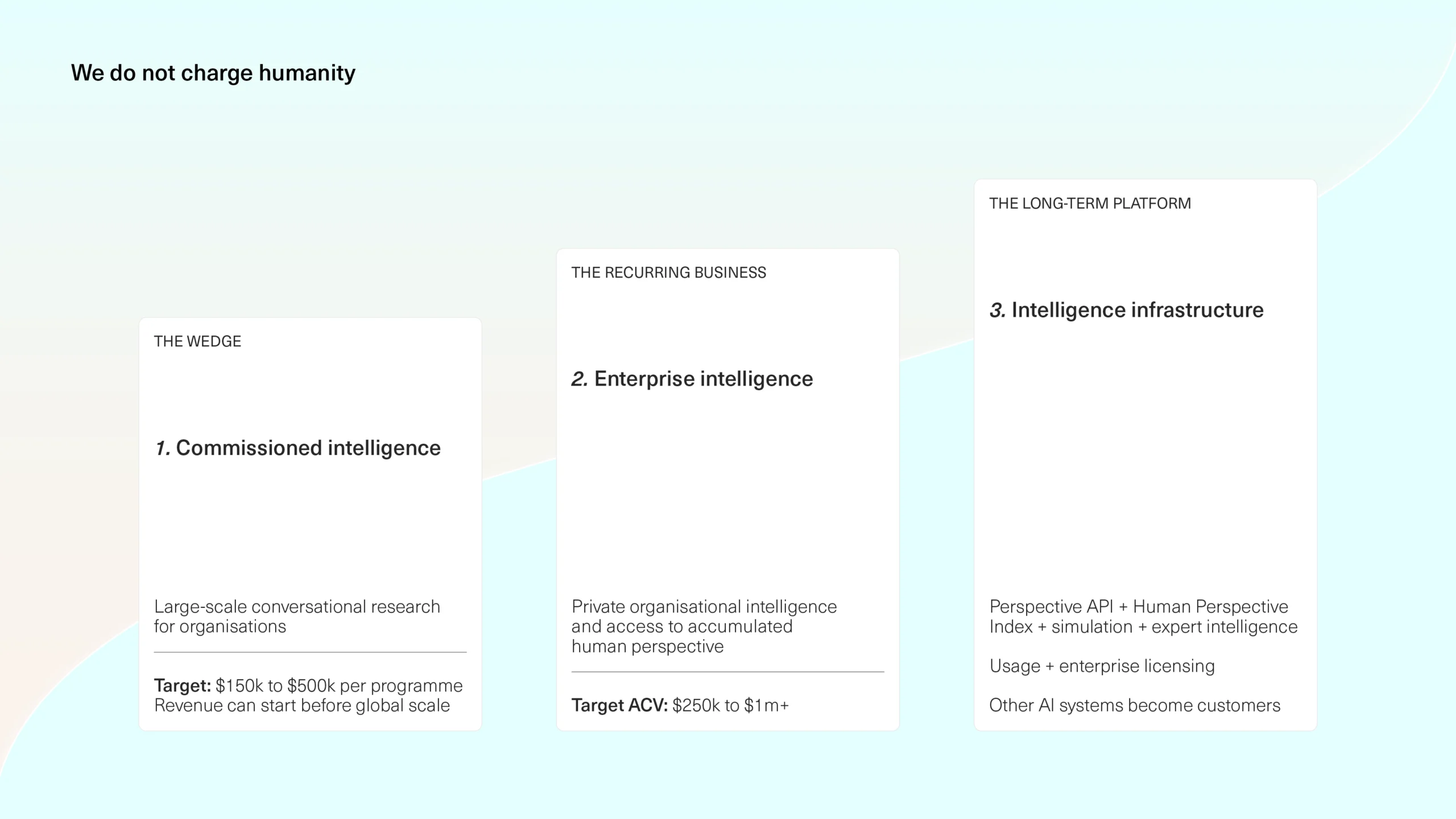
Commissioned intelligence is the starting point. The accumulating intelligence is the business.


We do not charge people
This part matters. The people creating the perspective layer are not the customers. Organisations are. We want participation to be something people choose because the experience itself has value and because the relationship is built around clear permission. Commercial value sits on the other side of that relationship.
Today, that means commissioned intelligence. Then persistent enterprise intelligence. In time, it means infrastructure that allows other systems to reason with human perspective that they could not otherwise access. That is how we see Sentiment AI becoming useful to both sides without turning the participant into the product.


What we are raising for
We possibly should have put the ask up front, but if you made it this far…
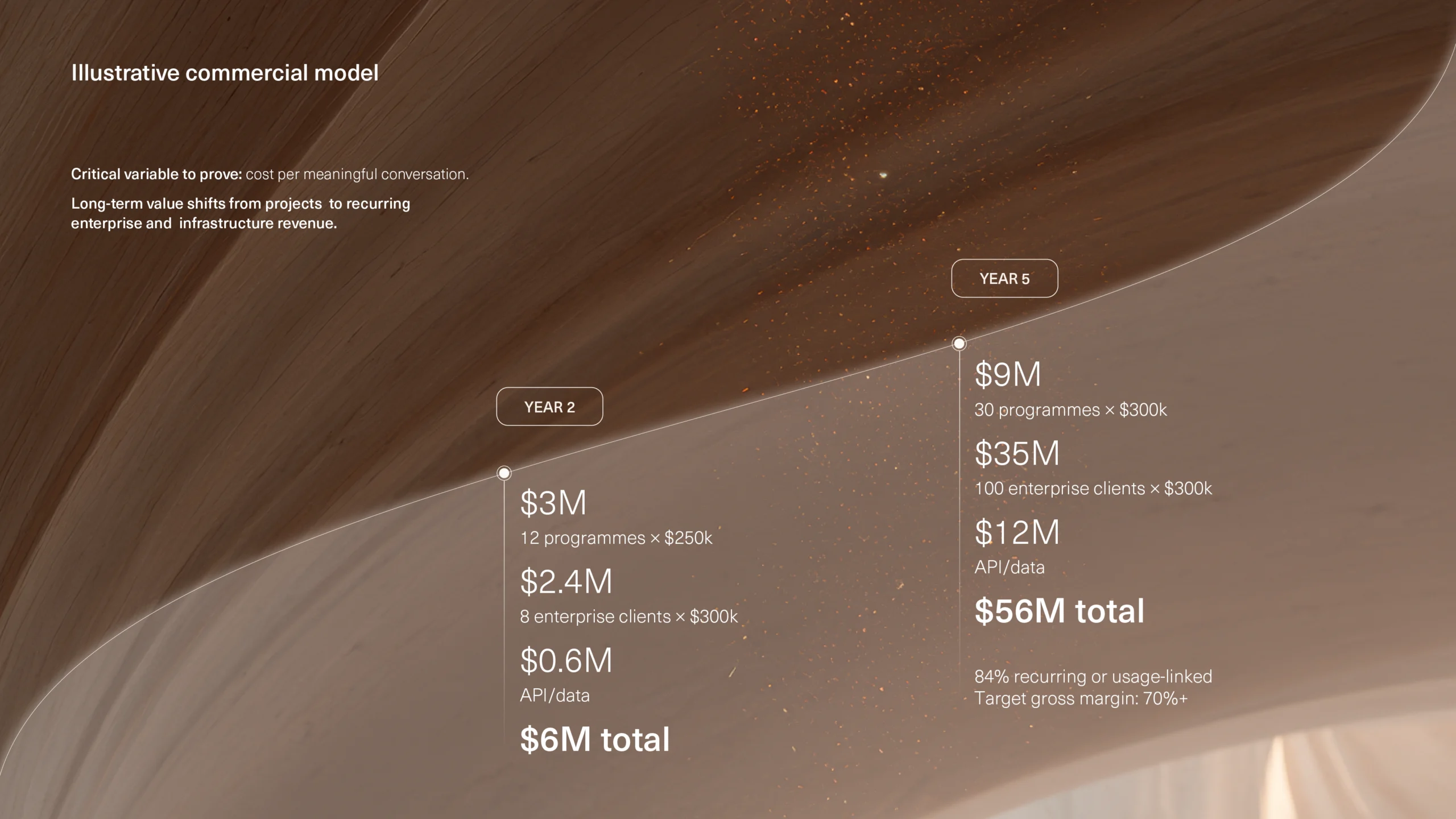
We are raising a $7M seed round to prove the most important parts of this over the next 24 months. We will build the perspective graph and show that persistent conversation genuinely produces better intelligence. We will have enough people returning often enough for continuity to become meaningful. We will prove the commercial demand through real enterprise programmes, then understand how those relationships move from projects towards recurring intelligence.
There is important work around governance too. Permission and privacy cannot be something we bolt on later. They must be part of how the system works from the beginning. And there is one economic question we care about enormously:
What does a meaningful human conversation cost at scale?
When we can answer that, a very interesting business emerges. One where commissioned work can fund the growth of a proprietary intelligence asset. One where the asset becomes more useful as people return. One where the hardest thing for a competitor to recreate is not the technology. It is the history.
The idea is quite simple. AI is becoming extraordinarily good at answering questions. We think it should also become extraordinarily good at asking people. And remembering what humanity tells it.
That is Sentiment AI.
For the full investor thesis, contact Will Hambling



Explore our articles
Original thinkers. Proven creators.
Why are you so sure?

Creative advantage in the age of generative systems

Aligning brand, purpose and strategy – A conversation with Eve Vlemincx | Part 2

Aligning brand, purpose and strategy – A conversation with Eve Vlemincx | Part 1

Discontinuous change and the break with old logic

“Work the heck?”: highlighting the dangers of the UK’s new policies to businesses, international talent and young people.
“Work the heck is going on?” A question everyone in the current job market has asked themselves at one point (and yes, pun intended).

Should digital transformation be applied to enhance tech efficiency in the shipping sector? AI, IoT, digital twins and more.

The science of building brands for the intangible
For years, Within International has specialised in building brands for the hardest thing to define: the intangible.

The case for neuroscience in business

Outside looking in: a call for change in shipping

The city that never sleeps
We usually work in words – but this time, the pictures said it better. A visual story from our recent New York adventure.